The Rooster News · Investigation

By Rahul, founder and editor · 19 August 2026

₹14,767 crore in donations. ₹8,452 crore still in the bank.

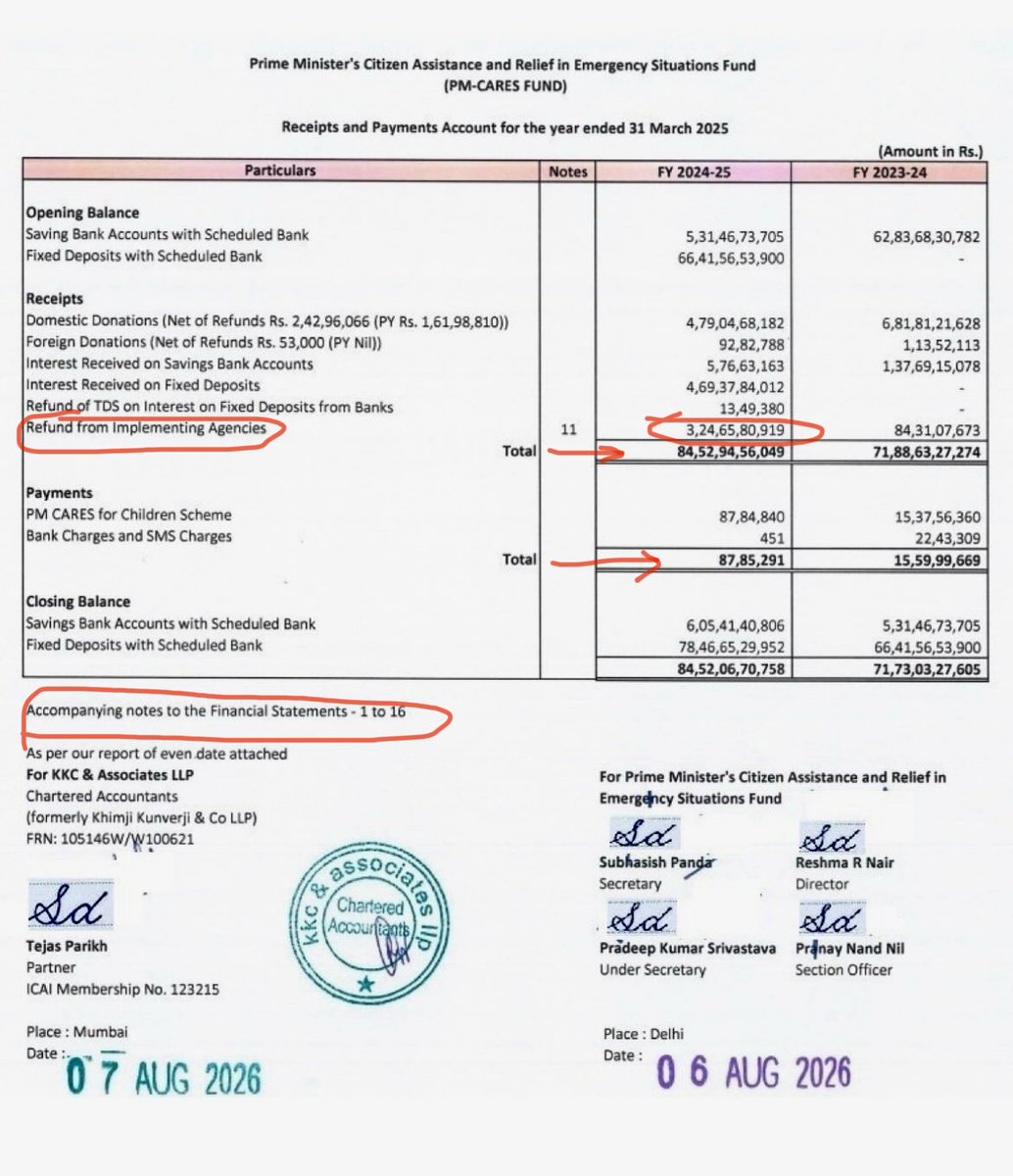
On the face of the six signed accounts, PM CARES took in ₹14,766.98 cr in donations and ₹1,178.56 cr in interest. Cash paid out was ₹8,148.33 cr. Agencies later sent back ₹654.86 cr. On 31 March 2025 the closing balance was ₹8,452.07 cr— ₹7,846.65 cr in fixed deposits.

FY 2024–25 is not a ₹3.31-crore spending year. The PDF shows ₹87.85 lakh in payments — 0.01% of the closing pile. The extra ₹2.43 crore is money returned to donors, not relief. Year by year, as printed. Five demands of the chair.

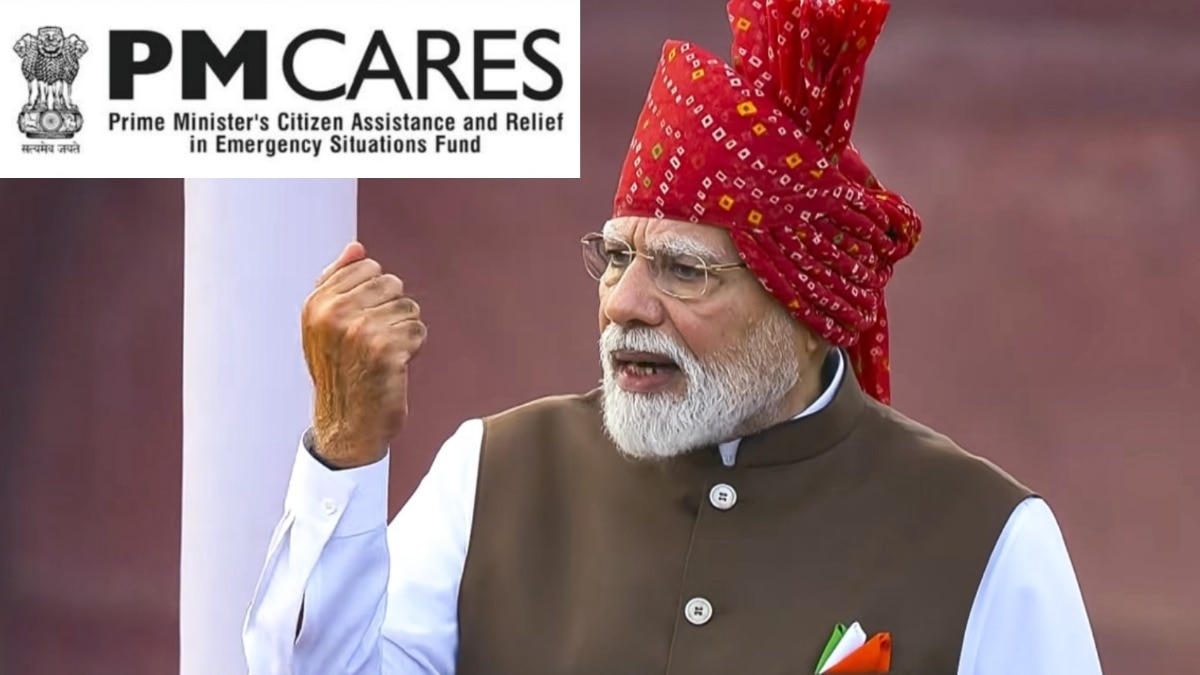
Narendra Modi, chair of the PM CARES Fund, with the fund’s official mark.
Photograph

Narendra Modi, ex-officio chairman of PM CARES. The fund uses his office, the State Emblem, and a gov.in domain. The appeal of 28 March 2020 was made in this name. Photo: India Today, August 2026.

Donations, as printed

₹14,767 cr

₹1,47,66,98,13,169 · interest is another ₹1,178.56 cr

Sum of the donation lines on the six receipts faces (net of donor refunds in FY24–FY25). Do not call this “₹15,946 crore in donations” — that figure folds in interest. Agency refunds are a third column, not a donation.

Paid out

₹8,148 cr

net of agency refunds ₹7,490.24 cr

Total Payments on the six accounts. Donor refunds are a payment in FY22–FY23 and are netted against donations in FY24–FY25. They are not relief spending.

Still in the bank

₹8,452 cr

57.2% of donations · ₹7,846.65 cr in FDs

31 March 2025. ₹7,846.65 crore in fixed deposits; ₹605.41 crore in savings. Interest that year, ₹475.28 crore, almost matched fresh domestic donations. Programme spend was ₹87.85 lakh — 0.01% of this pile.

What this fund is — and is not

The Prime Minister's Citizen Assistance and Relief in Emergency Situations Fund is a public charitable trust set up on 27 March 2020. The Prime Minister is the ex-officio chair. It is not a line in the Union Budget, and it is not paid for by a parliamentary appropriation from the Consolidated Fund of India.

So when these accounts say money was “spent”, they mean the trust disbursed donated money — from individuals, companies and public-sector undertakings — plus the interest that money later earned in the bank. The receipts-and-payments accounts do not name donors, so we cannot split “PSU money” from “private money”. We can only split what the auditor split: domestic donations, foreign donations, and interest.

Foreign contributions are real, but small after the first full year: ₹494.92 crore in FY21, then a trickle. Interest is not small. By FY25, interest on the fixed deposits alone (₹469.38 crore) almost matched the entire year's domestic donations.

01 — Year by year

In, out, and the pile that stayed.

Bars are donations-plus-interest and the PDF payments total, in crore. The line is the closing balance. After FY22 the fund takes in more than it spends, every year. Agency refunds are a third column — not “came in”, not “spent”.

₹ crore · bars = donations + interest / payments · line = closing

YearDonationsInterestAgency refundsPaymentsClosing
2019–20stub₹3,076.27 cr₹0.35 cr—₹0.02 lakh₹3,076.63 cr
2020–21₹7,678.69 cr₹234.6 cr₹0.25 cr₹3,976.17 cr₹7,014 cr
2021–22₹1,936.88 cr₹160.26 cr₹20.81 cr₹3,716.29 cr₹5,415.66 cr
2022–23₹912.21 cr₹170.38 cr₹224.83 cr₹439.38 cr₹6,283.68 cr
2023–24₹682.95 cr₹137.69 cr₹84.31 cr₹15.6 cr₹7,173.03 cr
2024–25₹479.98 cr₹475.28 cr₹324.66 cr₹0.88 cr₹8,452.07 cr
Six-year total₹14,766.98 cr₹1,178.56 cr₹654.86 cr₹8,148.33 cr₹8,452.07 cr

1 Apr 2020 – 31 Mar 2021

2020–21

The COVID year. Largest inflow and the first large disbursals: ventilators, migrant welfare, vaccines, oxygen plants.

Audited by SARC & Associates · signed 11 January 2022

Opening
₹3,076.63 cr
Domestic donations
₹7,183.78 cr
Foreign donations
₹494.92 cr
Interest
₹234.6 cr
Donations + interest
₹7,913.3 cr
Agency refunds in
₹0.25 cr
Payments (PDF total)
₹3,976.17 cr
Donor refunds (shown as a payment)
₹0 cr
Closing
₹7,014 cr
  • Vaccine doses₹1,392.83 cr
  • Ventilators₹1,311.34 cr
  • Migrant welfare₹1,000 cr
  • 162 PSA plants₹201.58 cr
  • Bihar hospitals & RT-PCR₹50 cr
  • CDL labs₹20.42 cr
  • Admin₹0.01 cr

02 — Source of funds

Almost nine rupees in ten were domestic donations.

The accounts have three incoming pipes: voluntary contributions from inside India (plus a ₹2.25 lakh initial corpus), foreign contributions, and bank interest. They do not say who the donors were.

Domestic donations + corpus

₹14,226.91 cr

89.2% of new money

Foreign donations

₹540.07 cr

3.4% of new money

Interest (incl. TDS refund)

₹1,178.56 cr

7.4% of new money

₹ crore · stacked by source

YearDomesticForeignInterestDonations + interest
2019–20₹3,075.88 cr₹0.40 cr₹0.35 cr₹3,076.63 cr
2020–21₹7,183.78 cr₹494.92 cr₹234.6 cr₹7,913.3 cr
2021–22₹1,896.76 cr₹40.12 cr₹160.26 cr₹2,097.14 cr
2022–23₹909.64 cr₹2.57 cr₹170.38 cr₹1,082.59 cr
2023–24₹681.81 cr₹1.14 cr₹137.69 cr₹820.64 cr
2024–25₹479.05 cr₹0.93 cr₹475.28 cr₹955.25 cr

FY21 is the foreign-money year: ₹494.92 crore, 6.3% of that year's intake. After that, foreign inflows collapse to a few crore a year. Interest does the opposite — it grows as the unspent corpus grows, and explodes in FY25 once most of the money is in fixed deposits. FY24 and FY25 print donations net of money returned to donors (₹1.62 crore and ₹2.43 crore). Those two years now follow the PDF face, not a grossed-up cash figure.

03 — What the money was spent on

Oxygen, vaccines, migrants — then almost nothing.

Gross disbursals to programmes were ₹8,144.61 cr. Implementing agencies later sent back ₹654.86 cr of unspent money (₹245.64 cr tagged to a named line; ₹409.22 cr lumped as “refund from implementing agencies” in FY24–FY25). Net programme spend: ₹7,489.75 cr.

Oxygen & critical care

₹5,155 cr

net ₹4,921.95 cr

Vaccines & labs

₹1,413 cr

net ₹1,412.9 cr

Hospitals

₹214 cr

net ₹201.86 cr

Welfare

₹1,000 cr

net ₹1,000 cr

Children

₹362 cr

net ₹362.25 cr

Gross bars · pale end-cap is money later refunded

ProgrammeGroupGross paidRefundedNet

50,000 Made-in-India ventilators

Supplied to government hospitals run by the Centre, states and Union territories. Paid across FY21 and FY22. Implementing agencies later returned ₹202.89 crore of unspent money.

Oxygen & critical care₹2,146.62 cr₹202.89 cr₹1,943.74 cr

Additional dedicated PSA oxygen plants

The single largest payment line in any year: ₹1,703.15 crore in FY22, after the second-wave oxygen crisis. Small unspent refunds followed.

Oxygen & critical care₹1,703.15 cr₹4.67 cr₹1,698.48 cr

6.6 crore COVID-19 vaccine doses

Procured in FY21. A ₹0.34 crore unspent balance was later refunded.

Vaccines & labs₹1,392.83 cr₹0.34 cr₹1,392.49 cr

Migrant welfare — allotted to states & UTs

₹1,000 crore sent to states and Union territories in FY21 for the welfare of migrant workers during the first lockdown.

Welfare₹1,000 cr—₹1,000 cr

99,986 oxygen concentrators

₹500 crore in FY22 and a further ₹91.87 crore in FY23.

Oxygen & critical care₹591.87 cr—₹591.87 cr

PM CARES for Children

Scheme for children who lost both parents or a surviving parent / legal guardian to COVID-19. A ₹10 lakh fixed deposit is held until age 18, with education and health cover. Almost all of the money went out in FY23; later years are small top-ups.

Children₹362.25 cr—₹362.25 cr

1.5 lakh SpO2 oxygen-control systems + 10 lakh NRMs

Pulse-oximetry-based oxygen control systems with non-rebreather masks, plus 10 lakh extra masks.

Oxygen & critical care₹322.5 cr₹1.76 cr₹320.74 cr

162 PSA medical oxygen plants

First oxygen-plant package, installed inside public health facilities in FY21.

Oxygen & critical care₹201.58 cr₹23.86 cr₹177.73 cr

Liquid oxygen equipment (IOCL / MoPNG)

Procured by Indian Oil through the Ministry of Petroleum & Natural Gas.

Oxygen & critical care₹189.4 cr—₹189.4 cr

Two 500-bed makeshift hospitals — Jammu & Srinagar

One 500-bed COVID hospital in each city, FY22.

Hospitals₹82.94 cr—₹82.94 cr

Sardar Vallabhbhai Patel COVID hospital, Delhi Cantt.

Reactivation of the 500-ICU-bed DRDO hospital at Delhi Cantonment.

Hospitals₹67.95 cr—₹67.95 cr

Makeshift hospitals in Muzaffarpur & Patna + 16 RT-PCR labs

Two 500-bed hospitals and 16 testing labs across 9 states/UTs. A large share of the original ₹50 crore later came back unspent.

Hospitals₹50 cr₹12.13 cr₹37.87 cr

Two DBT labs upgraded as Central Drug Laboratories

Autonomous institute laboratories under the Department of Biotechnology, upgraded to test and release COVID-19 vaccine batches.

Vaccines & labs₹20.42 cr—₹20.42 cr

Atal Bihari Vajpayee COVID hospital, Lucknow (DRDO)

Makeshift 500-bed hospital built by DRDO.

Hospitals₹13.1 cr—₹13.1 cr
Unallocated agency refundsReturned, line not named—₹409.22 cr−₹409.22 cr
All programmes₹8,144.61 cr₹654.86 cr₹7,489.75 cr

04 — What remains

The fund is now mostly a fixed-deposit book.

In FY24 the trustees moved ₹6,641.57 cr into fixed deposits. A year later that pile is ₹7,846.65 cr, and it earned ₹475.28 cr — more than the year's foreign donations, and nearly as much as all domestic donations (₹479.98 cr).

31 March 2025

₹8,452.07 cr

Fixed deposits₹7,846.65 cr
Savings accounts₹605.41 cr

FY25 run-rate

Programme spend
₹0.88 cr
Bank charges
₹451
Interest earned
₹475.28 cr
Spend as % of closing pile
0.010%

After the pandemic years the trust is collecting interest and refunds, not deploying a COVID-scale programme. The only named spend left is PM CARES for Children.

Year-endSavingsFixed depositsTotal held
31 Mar 2020₹3,076.63 cr—₹3,076.63 cr
31 Mar 2021₹7,014 cr—₹7,014 cr
31 Mar 2022₹5,415.66 cr—₹5,415.66 cr
31 Mar 2023₹6,283.68 cr—₹6,283.68 cr
31 Mar 2024₹531.47 cr₹6,641.57 cr₹7,173.03 cr
31 Mar 2025₹605.41 cr₹7,846.65 cr₹8,452.07 cr

05 — The year the money sat

Wayanad slid. Assam drowned. The corpus earned interest.

FY 2024–25 is the year the trust spent ₹87.85 lakh — ₹87,85,291 — and earned ₹475.28 cr sitting in the bank. The name on the deed is Citizen Assistance and Relief in Emergency Situations. These were the emergencies.

PM CARES, FY25 payments

₹87.85 lakh

Children scheme + ₹451 bank charges. No flood line. No landslide line. No cyclone line.

Centre, same year — SDRF + NDRF

₹23,131 cr

₹18,322.80 crore SDRF to 27 states and ₹4,808.30 crore NDRF to 18 states, per the Home Ministry’s FY25 tally. Public money, public rules.

Still in PM CARES on 31 Mar 2025

₹8,452 cr

More than half of everything ever donated, parked, while the Union sent NDRF files to the same hills and riverbanks.

  1. 01 · 30 July 2024

    Wayanad, KeralaLandslides

    Mundakkai, Chooralmala and nearby villages were buried after two days of extreme rain. Hundreds died. The Prime Minister flew over the hills on 10 August and announced PMNRF ex-gratia — ₹2 lakh to the next of kin, ₹50,000 to the injured. PM CARES, of which he is ex-officio chair, records no landslide line on the FY25 payments face. The year’s entire programme spend is ₹87.85 lakh, on the Children scheme.

  2. 02 · Monsoon 2024

    AssamFloods

    The Brahmaputra did what it does every year, only worse in pockets. An Inter-Ministerial Central Team was sent. Relief that moved, moved through SDRF and NDRF — the Consolidated Fund. Not the ₹8,452 crore sitting in scheduled-bank accounts in the Prime Minister’s name.

  3. 03 · August 2024

    TripuraFloods

    Flash floods and landslides cut the state. In February 2025 the Home Ministry’s high-level committee cleared ₹288.93 crore of additional NDRF for Tripura as part of a ₹1,554.99 crore five-state package. PM CARES is not in that table.

  4. 04 · Monsoon 2024

    Andhra Pradesh & TelanganaFloods / flash floods

    The same February 2025 package sent ₹608.08 crore of NDRF to Andhra Pradesh and ₹231.75 crore to Telangana. Two states, two lines, public money, a public auditor. The private-trust pile next door did not stir.

  5. 05 · Monsoon 2024

    GujaratFloods

    An IMCT was constituted. Damage was assessed under NDRF/SDRF rules. Nothing equivalent appears in the PM CARES receipts-and-payments account for the year.

  6. 06 · Monsoon 2024

    BiharFloods

    Twenty-five dead on the Home Ministry’s own IMCT table as of November 2024. The state has lived with flood relief as a seasonal file. FY25 PM CARES still has one programme line: children who lost parents to COVID, years earlier.

  7. 07 · Monsoon 2024

    Himachal PradeshCloudbursts & flash floods

    Hillsides gave way again. Roads, houses, apple country. The Centre’s disaster window is SDRF/NDRF. The fund that was sold as “citizen assistance and relief in emergency situations” earned ₹475 crore on fixed deposits that year.

  8. 08 · May & October 2024

    Odisha & West BengalCyclones Remal and Dana

    Remal made landfall in May; Dana in October. Evacuations, camps, power down. Odisha’s additional NDRF slice in the February 2025 package was ₹255.24 crore. Cyclone is the textbook emergency the trust’s name describes. The FY25 payments total is still ₹87.85 lakh.

And the schools.

Walk into a government school in the same districts that flooded. Roofs that leak. Toilets that don’t. Libraries that are a locked cupboard. Teachers on paper. The Annual Status of Education Report has said this, in public, for twenty years. UDISE+ still counts schools without a working toilet, without electricity, without a first-aid box. None of that is a secret.

PM CARES for Children is a ₹10 lakh fixed deposit for a child who lost both parents, or the surviving parent, to COVID — held until eighteen, with education and health cover. It is not a school building. It is not a toilet. It is not a teacher. In FY25 that scheme is the only programme on the payments face.

The trust deed is the chair’s to amend. The board is the Prime Minister and three cabinet ministers. If the emergency that filled the box is over, the question is not “can the deed fund a classroom.” The question is why a corpus that earned ₹475.28 cr doing nothing cannot be put to government schools — roofs, toilets, kitchens, books — in the states that just buried their dead. ₹87.85 lakh is not an answer. It is a refusal dressed as a scheme.

Put it to the chair: spend on the floods that came. Spend on the schools that are still wet. Or say, in the Lok Sabha, why not.

06 — The question from the feed

How transparent should a public-facing emergency fund be?

That is the sentence the books cannot answer, and the sentence the Instagram post of 16 August 2026 put back on the table. The accounts tell you the rupees. They do not tell you the donors. They do not travel through the RTI Act. This chapter puts the post next to the public record.

Source · Instagram@upscwith_sagar · 16 August 2026

The PM CARES Fund is back under scrutiny over a central question: how transparent should a public-facing emergency fund be?

Debates around RTI applicability, disclosure of donations and institutional accountability continue to raise important governance concerns.

The issue sits at the intersection of transparency, public trust, executive accountability and the right to information.

Posted by Sagar Bhagat. The slides themselves are not reproduced here — Instagram blocks the files. The caption is.

Open the post

Three questions in the caption

RTI, donors, accountability. Answered from the accounts you have already read, and from the court and commission record the accounts never mention.

  1. 01

    Does the Right to Information Act apply?

    The PMO’s consistent answer since 2020 is no: the trust is not a “public authority” under the RTI Act, 2005. The Supreme Court in August 2020 refused to force a CAG audit. The Delhi High Court on 13 January 2026 called it a “juristic or government entity” and still left a privacy claim standing. A 2022 CIC order that the Income Tax department disclose the fund’s tax-exemption file was quashed the same year; the appeal is pending. So: you cannot today walk into a PIO’s office and demand the donor list.

  2. 02

    Are donations disclosed?

    Only as three pipes — domestic, foreign, interest. The six receipts-and-payments accounts never name a donor, a company, or a PSU. Official FAQ text says budgetary transfers from PSUs are not accepted, but CSR from companies and PSUs is, and it is not broken out. Foreign money is FCRA-exempt. The first rupees in the book are a ₹2.25 lakh corpus; the PMO has said that was the Prime Minister’s own seed. Everything after that is a total.

  3. 03

    What institutional accountability exists?

    A private chartered accountant (SARC & Associates through FY23; KKC & Associates LLP for FY24–25), not the CAG. The statements are uploaded on pmcares.gov.in. Parliament is told questions do not lie, because the money is not from the Consolidated Fund. The trustees are the Prime Minister and the Defence, Home and Finance ministers, sitting ex officio; the PMO says that is “administrative convenience,” not government control. The trust uses the State Emblem and a gov.in domain. There was no Cabinet agenda to create it.

What these six accounts do show

  • Year-wise receipts: domestic donations, foreign donations, interest, agency refunds
  • Year-wise payments, named by programme
  • Opening and closing bank balances, and (from FY24) the split between savings and fixed deposits
  • Name of the private chartered-accountant firm and the date the account was signed
  • That donor refunds exist, and (from FY24) their rupee total

What they still do not show

  • Who donated, and how much — no donor list, no PSU/private split
  • Vendors, unit prices, tender method, or how many units were actually delivered
  • The auditor’s qualifications, emphasis-of-matter, or management letter — only the R&P face is public
  • Unspent money still sitting with implementing agencies
  • Names of children on the PM CARES for Children scheme, or how many FDs were opened
  • Why the corpus was moved into fixed deposits rather than spent

A public-record timeline

The Instagram post landed two days after FY24 and FY25 were signed, and two weeks after newspapers flagged a two-year hole on the website. The hole was real. The new statements close it — as receipts and payments, not as an RTI file.

  1. 27 Mar 2020

    Trust registered

    Registered as a public charitable trust under the Registration Act, 1908, at New Delhi. Prime Minister is ex-officio chair; Defence, Home and Finance ministers are ex-officio trustees. Announced the next day.

  2. Jun 2020

    No Cabinet agenda

    Cabinet Secretariat reply to an RTI (Anjali Bhardwaj): there was no agenda item in any Cabinet meeting specifically related to creating the fund.

  3. Aug 2020

    Supreme Court, CPIL

    Court refuses to order a transfer of the corpus to the National Disaster Response Fund, or a CAG audit. It treats the fund as a public charitable trust of voluntary contributions, auditable by a private accountant.

  4. 2020–21

    PMO: not a public authority

    Repeated RTI replies from the PMO: the trust is not a “public authority” under the RTI Act, 2005, so the office will not disclose the trust deed, donor lists, or internal papers under that Act.

  5. 27 Apr 2022

    CIC vs Income Tax

    Central Information Commission directs the Income Tax department to give Girish Mittal details of tax exemptions granted to the fund. A single judge of the Delhi High Court quashes that order in July 2022. The appeal is still live.

  6. Jan 2023

    PMO affidavit

    In the Delhi High Court the PMO says the trust is “neither intended to be nor is in fact owned, controlled, or substantially financed by any government,” and is not “the State” under Article 12.

  7. 13 Jan 2026

    Delhi High Court

    A bench observes that although the fund is a “juristic or government entity”, it cannot be denied a claim to privacy under the RTI Act. The tax-exemption appeal remains pending.

  8. Budget 2026

    Parliament questions blocked

    PMO writes to the Lok Sabha Secretariat that questions on the fund cannot be taken up: it is not paid from the Consolidated Fund, and Rule 41 keeps out matters “not primarily the concern” of the Union government. Former LS Secretary-General P.D.T. Achary says admission of questions is the Speaker’s, not the PMO’s.

  9. 31 Jul 2026

    The audit gap is noticed

    Public reporting (The Hindu and others) notes that no audited statement later than FY 2022–23 is on the website. That gap is real: FY23 was signed 29 March 2024; FY24 and FY25 are signed only on 6–7 August 2026.

  10. 16 Aug 2026

    The Instagram question

    Sagar Bhagat (@upscwith_sagar) posts the carousel this chapter answers: how transparent should a public-facing emergency fund be?

07 — The appeal, then the lock

He asked the country to pay. Then he locked the books.

On 28 March 2020 the Prime Minister, in his own name, asked Indians for money. Four days later the trust held ₹3,076.63 cr. Six years later the same chair has kept the donor list, the CAG and the Lok Sabha off the file. The two newspapers of 18 August 2026 only restated what these accounts already say. The argument is not the rupees. The argument is the silence around them.

@narendramodi · 28 March 2020tweet 1

People from all walks of life expressed their desire to donate to India’s war against COVID-19. Respecting that spirit, the Prime Minister’s Citizen Assistance and Relief in Emergency Situations Fund has been constituted. This will go a long way in creating a healthier India.

Open the tweet

@narendramodi · 28 March 2020tweet 2

It is my appeal to my fellow Indians, Kindly contribute to the PM-CARES Fund. This Fund will also cater to similar distressing situations, if they occur in the times ahead.

Open the tweet

@narendramodi · 28 March 2020tweet 3

The PM-CARES Fund accepts micro-donations too. It will strengthen disaster management capacities and encourage research on protecting citizens. Let us leave no stone unturned to make India healthier and more prosperous for our future generations.

Open the tweet

Read those sentences again. Citizen assistance. Emergency. Disaster management. Research. A healthier India. Micro-donations. Future distressing situations. He did not say “private trust.” He did not say “outside RTI.” He did not say “the Comptroller and Auditor General will not see this.” He did not say “Parliament may not ask.” Those doors were shut later, by the same office that made the appeal.

Three doors, locked from inside

A fund that uses the Prime Minister’s name, the State Emblem, a gov.in domain, three Union ministers as trustees, 80G, CSR and FCRA exemption, and the whole machinery of missions and ministries to raise money, is then described as a private charitable trust when anyone asks to see the list.

  1. RTI

    Not a public authority

    The PMO’s line since June 2020: the trust is not a “public authority” under the Right to Information Act, 2005. Citizen applications for the trust deed, donor lists and internal papers are refused. A 2022 CIC order telling the Income Tax department to open the tax-exemption file was quashed. The Delhi High Court in January 2026 still left a privacy claim standing.

  2. CAG

    Not the Comptroller and Auditor General

    The Supreme Court in August 2020 refused to order a CAG audit. The books are signed by a private chartered-accountant firm — SARC, then KKC. That is not the same as a public audit. There is no published management letter, no UDIN on the face of the statements the critics examined, and no notes to accounts on the website.

  3. Parliament

    Questions do not lie

    Ahead of the 2026 Budget session the PMO wrote to the Lok Sabha Secretariat that questions on the fund cannot be taken up: the money is not from the Consolidated Fund, and Rule 41 keeps out matters “not primarily the concern” of the Union government. Former Secretary-General P.D.T. Achary said admission of questions is the Speaker’s, not the PMO’s. The chair of the trust is the Prime Minister. The House is told it cannot ask him.

Two papers, 18 August 2026

The Telegraph and Deccan Herald published the new statements the same day. Their headlines are the books, compressed. Their quotes are the questions the chair has not answered.

The Telegraph · 18 August 2026

Web Desk, with PTI

‘PM CARES? hardly’: Barbs and questions fly after Rs 8,452-crore fund reveal in audit

Opposition and transparency activists read the new statements as a pile of idle money raised in an emergency that is over.

  • ₹8,452 crore sitting idle while people suffer. PM CARES? Hardly.

    Pawan Khera, Congress

  • Modi govt owes India 3 answers: Who donated? Why is it not being spent? Why is it still hidden from public audit?

    Kushagra Saxena, Congress

  • 324 crore was refunded by implementing agencies — but no info on what these payments were for and why these were refunded? Which agency refunded?

    Anjali Bhardwaj, RTI activist

Deccan Herald · 18 August 2026

Shemin Joy

PM-CARES fund receives Rs 1,162.92 crore, spends only Rs 16.47 crore during 2023-25: Audit report

Two years of donations, two years of almost no programme. The headline numbers match these six accounts once donor refunds are netted the way the auditor nets them.

  • Finally the audit statement of PMCARES Fund for 2024-25 has been made public! Utilised only 0.01% of available ₹8,452 crore. 324 crore was refunded by implementing agencies — but no info on what these payments were for. The PMCARES Fund continues to evade public scrutiny by refusing to submit itself to the RTI Act.

    Anjali Bhardwaj (@AnjaliB_), the post Deccan Herald embedded

Checked against these six accounts · FY24 + FY25

Deccan Herald’s ₹1,162.92 crore is domestic plus foreign donations for the two years, net of money sent back to donors — the same netting the auditor uses. ₹16.47 crore is the two years of stated payments. Both numbers hold.

Donations in, two years
₹1,162.92 cr
Stated payments, two years
₹16.48 cr
Interest earned, two years
₹612.97 cr
FY25 spend / closing pile
0.010%

In two years the pile earned ₹612.97 cr sitting in the bank, and spent ₹16.48 cr — 2.7% of the interest, and 1.4% of the new donations. The rest is still there. ₹7,846.65 cr of it is in fixed deposits.

Five questions. No answer from the chair.

  1. 01

    Who donated?

    The receipts-and-payments accounts never name a person, a company, a PSU, or a foreign donor. CSR was made eligible the day the fund was announced. Budgetary transfers from PSUs are officially not accepted — CSR from those same PSUs is. You cannot check either claim from these books.

  2. 02

    Why sit on ₹8,452 crore after the emergency that raised it?

    FY25 programme spend is ₹87.85 lakh — 0.01% of the closing pile. In FY24 and FY25 together the trust took in ₹1,162.92 crore of donations (net of donor refunds) and spent ₹16.48 crore. Interest on the fixed deposits in those two years, ₹612.97 crore, is thirty-seven times the spend. The standing defence is “reserved for the next crisis.” The appeal that filled the box was for this one.

  3. 03

    Why is it still outside public audit?

    Not RTI. Not CAG. Not Parliament. The FY24 year ended 31 March 2024; the signature is 7 August 2026 — twenty-eight months later. FY25 is sixteen months late. Private charitable trusts are still supposed to be audited. A two-year hole on the website is not a private convenience. It is a public silence.

  4. 04

    Which agencies sent ₹324.66 crore back, and why?

    FY25 shows ₹324.66 crore of refunds from implementing agencies, with no agency, no programme, no reason. Earlier years at least named the lines — ventilators, PSA plants, Bihar hospitals. Anjali Bhardwaj asked whether refunds were used to bury faulty equipment. The accounts cannot answer her. They were not built to.

  5. 05

    Where is the Prime Minister’s explanation?

    He is the ex-officio chair. He made the appeal in his own name. On 18 August 2026 the two papers that published these numbers quote the Opposition and an RTI activist. They do not quote him. They do not quote the Finance Minister. The PMO’s contribution is the standing line that questions do not lie, and that the trust is not a public authority. That is a refusal, not an explanation.

08 — Accountability

Five demands. Put them to the chair.

The Rooster News puts these to the Prime Minister, the three ex-officio trustees, and the PMO. The books are public. The answers are not. Until they are, PM CARES remains a public fund with private rules.

  1. 01

    Bring it under RTI

    Notify PM CARES as a public authority under the Right to Information Act, 2005. A fund that uses the Prime Minister’s name, the emblem and a gov.in domain cannot hide behind “private trust.”

  2. 02

    Give it to the CAG

    Order a Comptroller and Auditor General audit of the full corpus — donations, foreign inflows, fixed deposits, interest, agency refunds and every implementing-agency unspent balance — not a private chartered accountant’s receipts-and-payments face.

  3. 03

    Publish the donors

    Release the institutional donor list: every PSU, company, ministry drive and foreign contributor, with amounts. Individual small donors may be anonymised. CSR and public-sector money cannot be a secret.

  4. 04

    Open the notes

    Upload the notes to accounts, utilisation certificates, agency-wise refunds, vendor contracts and the criteria for the Children scheme. FY25’s ₹324.66 crore came back with no names. That is not an audit. It is a blank.

  5. 05

    Answer in Parliament

    Withdraw the PMO’s instruction that questions on the fund do not lie. The chair sits in the House. The three other trustees are ministers. Let the Lok Sabha ask why ₹8,452 crore sat in fixed deposits through Wayanad, the 2024 floods and two cyclones, and why government schools still wait.

Questions the government has not answered

Addressed to:

  • Shri Narendra Modi, Prime Minister, ex-officio Chair, PM CARES Fund
  • Minister of Defence, Minister of Home Affairs, Minister of Finance — ex-officio trustees
  • Prime Minister’s Office · Ministry of Finance · Cabinet Secretariat
  1. Q01

    Why did a fund raised by a Prime Minister’s public appeal — with the State Emblem, a gov.in domain, and three cabinet ministers as trustees — lock itself out of the RTI Act?

  2. Q02

    Who donated? How much came from PSUs, from private companies counting CSR, and from foreign sources? The receipts-and-payments accounts never name a donor.

  3. Q03

    Why were the FY24 and FY25 accounts signed only on 7 August 2026 — twenty-eight months after FY24 ended — against the trust deed’s own rule of a yearly audit?

  4. Q04

    Which implementing agencies returned ₹324.66 crore in FY25, for what, and were any refunds used to bury faulty equipment?

  5. Q05

    Why was ₹87.85 lakh — 0.01% of ₹8,452 crore — spent in FY25, in a year of Wayanad landslides, Assam and Tripura floods, Himachal cloudbursts and cyclones Remal and Dana, while the pile earned ₹475 crore sitting in fixed deposits?

  6. Q06

    The Centre released ₹18,323 crore of SDRF and ₹4,808 crore of NDRF the same year. Why did the faster, kinder twin — PM CARES — write no flood, landslide or cyclone cheque?

  7. Q07

    Will the chair put any of the idle corpus into government schools — roofs, toilets, kitchens, books — or will PM CARES for Children remain the only education line, a ₹10 lakh FD for COVID orphans, while classrooms leak?

  8. Q08

    Will the chair — the Prime Minister — answer in his own voice, or will the PMO go on telling the Lok Sabha that questions do not lie?

09 — From the record, and from X

What they said when the books finally appeared.

Anjali Bhardwaj’s 18 August post is the thread Deccan Herald embedded. The rest are party statements. None of them are the accounts. They are here because the chair of the trust has not answered them. Each card links to the original.

Featured · the post the papers used

Anjali Bhardwaj

@AnjaliB_ · RTI activist · Satark Nagrik Sangathan · 18 Aug 2026

Open on X
Finally the audit statement of PMCARES Fund for 2024-25 has been made public! Key highlights- -Utilised only 0.01% of available ₹ 8,452 crore! Why is the PMCARES Fund keeping such large sums of money idle? -324 crore was refunded by implementing agencies- but no info on what these payments were for and why these were refunded? Which agency refunded? Were refunds done to evade accountability for faulty equipment? -Why have accompanying notes to the audit report not been uploaded? A fund set up to help citizens during disasters, which has accumulated thousands of crores (including from foreign sources), is shrouded in secrecy. Still no information available on sources of funds. The PMCARES Fund continues to evade public scrutiny by refusing to submit itself to the RTI Act.
Screenshot from Anjali Bhardwaj’s post: PM CARES FY 2024-25, ₹8,452 crore available, 0.01% utilised.
The card she attached. 18 August 2026.

Anjali Bhardwaj

@AnjaliB_ · RTI activist · Satark Nagrik Sangathan

18 Aug 2026

So PMCARES Fund got its accounts for FY 2023-24 and 2024-25 audited only on August 7, 2026! This violates even the PMCARES Fund own trust deed which states that accounts will be audited once in every financial year. The resistance to transparency and scrutiny in PMCARES raises serious questions.

Open on X

Pawan Khera

@Pawankhera · Congress · Rajya Sabha, CWC

18 Aug 2026

Only 0.01% of the ₹8,452 crore available has been utilised — even as natural calamities devastate communities across the country and thousands need relief and rehabilitation. ₹8,452 crore sitting idle while people suffer. PM CARES? Hardly.

Open on X

Syed Naseer Hussain

@NasirHussainINC · Congress · Rajya Sabha, CWC

19 Aug 2026

The Modi Government has evaded accountability on the PM CARES Fund by refusing to submit it to the RTI Act. After a delay of two years, its FY 2024-25 audit statement has finally been made public. A fund created to help citizens during emergencies and disasters cannot remain shrouded in secrecy. Why is the Modi Government keeping thousands of crores idle when people across India face floods, cyclones, droughts and other disasters?

Open on X

Pawan Khera

@Pawankhera · Congress · Rajya Sabha, CWC

9 Feb 2026

PMO blocks Lok Sabha Secretariat from taking up questions & matters on PM CARES Fund, Prime Minister’s National Relief Fund and National Defence Fund. Democracy’s oxygen saturation levels are falling rapidly!

Open on X

Rahul Gandhi

@RahulGandhi · Congress · Leader of Opposition, Lok Sabha

17 Dec 2020

PM Cares- 'Chaliye, transparency ko vanakkam'!

Open on X

Indian National Congress

@INCIndia · Congress

11 May 2022

You donated your money to the PM Cares Fund. You thought it would help the country deal with the disaster that was Covid. What did you get in return? No hospital beds, no oxygen, no medicines, and no relief.

Open on X

Indian National Congress

@INCIndia · Congress

2 Jun 2022

Donations to PM Cares fund were not used as they should have- we saw that during the deadly second wave. But only in BJP’s New India can funds donated by the people, be loaned back to the people, at an interest. Only BJP can turn a relief fund into a profitable business scheme.

Open on X

Indian National Congress

@INCIndia · Congress

19 Nov 2024

The present CAG has been quiet and has gone into a slumber for the past 10 years. They have even refused to audit the PM CARES Fund, which has money that comes from the PSEs.

Open on X

Aam Aadmi Party

@AamAadmiParty · AAP

11 Feb 2026

आख़िर PM Cares फंड की जानकारियों को क्यों छुपा रही है मोदी सरकार? जनता की गाढ़ी कमाई से बने PM Cares फंड का पैसा कहां खर्च हुआ?

Open on X

All India Trinamool Congress

@AITCofficial · TMC

8 May 2023

PM CARES ki aap chronology samajhiye! Established by Govt yet not public. RTI filing not applicable. Crores of funds unspent. WHERE are the funds going?

Open on X

All India Trinamool Congress

@AITCofficial · TMC

12 Aug 2023

BJP’s endless failures — PM Cares Fund: SHAM. PM @narendramodi, your DECEIT is out in the open!

Open on X

10 — How to read the numbers

Notes on the accounts

  1. Source documents are the audited Receipts and Payments accounts for the periods ended 31 March 2020, 2021, 2022, 2023, 2024 and 2025. FY20–FY23 were signed by SARC & Associates; FY24 and FY25 by KKC & Associates LLP (formerly Khimji Kunverji & Co LLP) on 7 August 2026.
  2. Indian financial years run 1 April to 31 March. FY19–20 is a four-day stub after the trust was constituted on 27 March 2020.
  3. “New money” / “came in” is the donations line as printed on that year’s receipts face, plus interest (including the FY25 TDS refund on FD interest). Refunds of unspent grants from implementing agencies are shown separately — they are the same rupees coming home, not a second donation.
  4. Recheck, 19 August 2026: FY24 and FY25 had been grossed up. The auditor prints those two years’ donations net of money returned to donors (₹1.62 crore and ₹2.43 crore) and does not show those refunds as payments. The first version of this report added the refunds back on both sides, so FY25 “went out” read ₹3.31 crore against a PDF payments total of ₹0.88 crore, and six-year “paid out” was ₹8,152 crore instead of the ₹8,148 crore you get by adding the six Total Payments lines. Both sides now follow the signed face. FY20–FY23 still print donor refunds as payments; those years were already right. Programme disbursal lines, interest, agency refunds and all six closings were already right.
  5. FY24 and FY25 refunds from implementing agencies are not split by programme. Net spend on named lines is therefore slightly overstated if some of that ₹408.97 crore belongs to them; the all-programme net figure subtracts the lot.
  6. A few yearly totals in the printed PDFs differ from the sum of printed lines by ₹1–2, ordinary rounding. Closings used here are the printed closings.
  7. The accounts do not record commitments or unspent balances sitting with implementing agencies — only cash that has left, or come back to, the trust's own bank accounts.
  8. Chapter 06 is prompted by Sagar Bhagat's Instagram post of 16 August 2026 (@upscwith_sagar). The legal timeline draws on the Supreme Court's August 2020 CPIL order, CIC/Delhi High Court proceedings around Girish Mittal, the PMO's January 2023 affidavit, the Cabinet Secretariat's June 2020 RTI reply, Frontline (24 February 2026) and The Hindu (31 July 2026) on the audit-publication gap. It is not part of the audited R&P figures.
  9. Chapter 07 is a critical reading, not a second set of accounts. It quotes Narendra Modi's three tweets of 28 March 2020 (@narendramodi), and two newspapers of 18 August 2026: The Telegraph and Deccan Herald (Shemin Joy). Deccan Herald's ₹1,162.92 crore is FY24+FY25 domestic and foreign donations net of donor refunds; ₹16.47 crore is the two years of stated payments. Both match these books. The chapter's argument — that a public appeal in the Prime Minister's name cannot later be treated as a private silence — is the editor's, not the auditor's.
  10. Chapter 05 lists disasters inside FY 2024–25 — Wayanad landslides (30 July 2024), Assam, Tripura, Andhra Pradesh, Telangana, Gujarat, Bihar floods, Himachal cloudbursts, cyclones Remal and Dana — against the FY25 payments total of ₹87.85 lakh. SDRF ₹18,322.80 crore to 27 states and NDRF ₹4,808.30 crore to 18 states in FY25, and the extra ₹1,554.99 crore five-state NDRF package (Andhra Pradesh, Nagaland, Odisha, Telangana, Tripura), are from the Home Ministry / PIB as reported by The Hindu on 19 February 2025. PMNRF ex-gratia after Wayanad is the Prime Minister’s 10 August 2024 announcement, not a PM CARES line. The school argument is an editorial demand, not a claim that the present trust deed already funds classrooms.
  11. Chapter 08 is The Rooster News's five demands of the chair — RTI, CAG, donor list, notes to accounts, and Parliament — plus six questions addressed to the Prime Minister, the ex-officio trustees and the PMO. They are the editor's demands, not the auditor's.
  12. Chapter 09 quotes Anjali Bhardwaj's 18 August 2026 post (@AnjaliB_— the thread Deccan Herald embedded), her follow-up on the trust deed, and party posts from Pawan Khera, Syed Naseer Hussain, Rahul Gandhi, @INCIndia, @AamAadmiParty and @AITCofficial. They are politics, with a link on every card. They are not evidence of how the rupees moved — the accounts are.
  13. Lead photograph: Narendra Modi with the PM CARES mark (India Today, 18 Aug 2026). Used as news illustration, credited on the page.